Will Art Garfunkel Join Paul Simon at Msg Shows ?
| The Concert in Central Park | ||||
|---|---|---|---|---|
 | ||||
| Live album by Simon & Garfunkel | ||||
| Released | February xvi, 1982 (1982-02-16) | |||
| Recorded | September nineteen, 1981 | |||
| Venue | Neat Backyard, New York Metropolis | |||
| Genre | Folk rock | |||
| Length | 75:51 | |||
| Characterization | Warner Bros. | |||
| Producer | Paul Simon, Art Garfunkel, Roy Halee, Phil Ramone | |||
| Simon & Garfunkel chronology | ||||
| ||||
The Concert in Primal Park is the first live album by American folk rock duo Simon & Garfunkel, released on February 16, 1982, by Warner Bros. Records. It was recorded on September 19, 1981, at a free do good concert on the Great Lawn in Primal Park, New York City, where the pair performed in forepart of an audition reported at the time every bit 500,000 people.[1] [2] Later estimates adamant that the maximum number of people who could fit in the park space was 48,500.[3] A film of the event was shown on Tv and released on video. Gain went toward the redevelopment and maintenance of the park, which had deteriorated due to lack of municipal funding. The concert and album marked the start of a 3-year reunion of Paul Simon and Art Garfunkel.
The concept of a do good concert in Fundamental Park had been proposed past Parks Commissioner Gordon Davis and promoter Ron Delsener. Tv channel HBO agreed to carry the concert, and they worked with Delsener to decide on Simon and Garfunkel as the appropriate act for this event. As well hit songs from their years equally a duo, their ready-list included cloth from their solo careers, and covers. The testify consisted of 21 songs, though two were not used in the alive album. Among the songs performed were the classics "The Audio of Silence", "Mrs. Robinson", and "The Boxer"; the event concluded with a reprise of Simon's song "Belatedly in the Evening". Ongoing personal tensions between the duo led them to determine against a permanent reunion, despite the success of the concert and a subsequent earth tour.
The album and flick were released the year after the concert. Simon and Garfunkel's functioning was praised past music critics and the album was commercially successful; it peaked at number six on the Billboard 200 album charts and was certified double platinum past the Recording Industry Association of America (RIAA). The video recordings were initially broadcast on HBO and were afterward fabricated available on Laserdisc, CED, VHS and DVD. A single was released of Simon and Garfunkel's live functioning of The Everly Brothers's vocal "Wake Upwards Little Susie", which reached No. 27 on the Billboard Hot 100 in 1982; it is the duo's last Top twoscore hit.
Thought and arrangement [edit]
A concert for the park [edit]
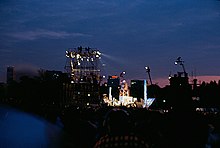
View of the stage from deep in the audience
New York Urban center'southward Central Park, an oasis that functions as the city's "green lung", was in a land of deterioration in the mid-1970s.[4] [5] Though Fundamental Park had been designated a National Historic Landmark in 1962,[vi] at the start of the 1980s, the city lacked the financial resources to spend an estimated U.s.a.$3,000,000 to restore[iv] or even to maintain the park. The nonprofit Central Park Salvation was founded in 1980, and began a successful campaign to heighten renovation funds.[7]
In the early 1980s, Parks Commissioner Gordon Davis, responsible for New York City'due south green areas, and Ron Delsener, one of the city's most influential concert promoters, developed the idea of helping Primal Park financially with a gratis open-air concert, under the legal guidance of Bob Donnelly. The metropolis would use profits from merchandising, television receiver, and video rights to renovate the park. Earlier park performances by Elton John and James Taylor showed that this concept could be a success. Davis authorized the project, and Delsener entered discussions with cable Telly channel HBO to decide who would perform.[eight] [9]
They decided on Simon & Garfunkel, a group that had formed in New York City in the 1960s and had been one of the most successful folk rock groups through the late 60s/early 70s.[10] [11] Simon & Garfunkel had broken up at the acme of their popularity and before long after the release of their fifth studio album, Bridge Over Troubled Water, which is deemed to be their artistic peak and which topped the 1970 Billboard charts for 10 weeks. They had grown apart artistically and did not get forth well with each other. In the following eleven years, both continued musical careers equally solo artists and worked together only sporadically on unmarried projects.[12] Garfunkel made brief invitee appearances at Simon'due south concerts, which were always successful.[8] [9]
Delsener presented the programme to Paul Simon in the summer of 1981. Simon was enthusiastic nigh the thought, but questioned whether information technology could be financially successful, especially given the poor audience omnipresence of his last projection, the autobiographical film One-Trick Pony. Simon's confidence had declined and he had sought treatment for depression.[13] [14] He questioned whether he and Art Garfunkel could work together,[x] [11] but contacted Garfunkel, who was vacationing in Switzerland. Garfunkel was excited nearly the idea and immediately returned to the Usa.[8] [nine]
From the promoter'south viewpoint, Simon and Garfunkel were ideal choices. Not simply were they likely to draw a big crowd to the concert, they likewise had roots in the city[8] – both had grown upward and gone to schoolhouse in Wood Hills, Queens.[14] [fifteen] Music critic Stephen Holden pointed out that, dissimilar artists who had left in pursuit of lifestyles offered past other locales, the 2 had ever been a function of New York Metropolis. Both gained inspiration from the cityscape and the cultural variety of New York, and they spoke of these influences in their songs.[16]
Planning and rehearsals [edit]
Planning and rehearsals for the concert took near iii weeks in a Manhattan theater.[nine] The rehearsals were characterized past past tensions that resurfaced between the performers under the intense fourth dimension pressure. Paul Simon later said: "Well, the rehearsals were just miserable. Artie and I fought all the time."[14] An early on concept was for each singer to give a solo performance, with Simon allotted the greater amount of time, and to conclude with the duo performing their joint works. This idea was rejected because, according to Garfunkel, "It didn't seem right to either of us that Paul should be the opening act for Simon & Garfunkel, and for him to follow Simon & Garfunkel didn't make show-business sense".[17] The two decided to perform most of the prove together, with room for each to showcase some solo textile.[ix] Simon, who had resumed songwriting later a long hiatus, interrupted a series of studio recording sessions for the concert preparations. He used the live bear witness as an opportunity to test one of his new songs in front of an audition. Garfunkel as well planned to present a new vocal, "A Heart in New York", from his soon-to-be released album Scissors Cut.[9]
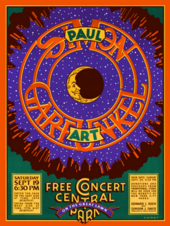
The two differed on the presentation of the concert. Garfunkel wanted to recreate the duo's mid-1960s live performances, using only their voices backed by Simon's acoustic guitar. Simon felt that this was incommunicable, equally an injury had rendered him incapable of playing guitar for the full length of a concert, and his newer fabric was typically arranged for larger ensembles that often included horns and amplified instruments such as electric piano and electric guitar. Garfunkel initially agreed to hire a second guitarist, merely later rejected the thought. A group of 11 musicians was assembled for the concert,[14] [xviii] nearly of whom were experienced studio musicians and had played on albums involving Simon or Garfunkel and these included Baton Joel'due south guitarist David Dark-brown (guitar), Musculus Shoals guitarist Pete Carr (guitar), Anthony Jackson (bass guitar), Rob Mounsey (synthesizer), John Eckert (trumpet), John Gatchell (trumpet), Dave Tofani (saxophone), Gerry Niewood (saxophone), Steve Gadd and Grady Tate (drums, percussion), and Richard Tee (piano).[nineteen]
The musical arrangements for the concert were written by Paul Simon and David Matthews. Some songs differed significantly from their original versions; for example, "Me and Julio Downwards by the Schoolyard" featured more prominent Latin elements and included a salsa break, while the folk rock "Kodachrome" was set as a harder rock vocal and played together with the Chuck Berry classic "Maybellene" as a medley.[16]
Garfunkel had difficulties in the rehearsals. Both men easily recalled their songs from the 1960s, but Garfunkel had to learn the harmonies and arrangements for Simon's solo songs, as modified for the reunion concert.[20] He was also uncomfortable that Simon had rewritten some of the lyrics for their quondam songs. Despite the need to adapt to Simon and his way, Garfunkel enjoyed some of the songs, and was glad to perform a duet version of Simon'due south "American Tune".[18]
News reports[21] and the Michael Doret-designed posters[22] of the Key Park bear witness named the musicians individually and did not bill them every bit "Simon & Garfunkel"; that the two singers would perform together on stage in a reunion was not officially announced until just a week before the concert when information technology was published in New York newspapers.[9] The two stated in interviews that further collaboration was non planned.[19] [23]
Concert [edit]

The audience waits on the "Great Lawn" for the concert's outset
The concert took place on Sabbatum, September nineteen, 1981, on the Corking Lawn, the cardinal open space of Fundamental Park. The first spectators, many conveying chairs or picnic blankets, arrived at daybreak to secure a skilful spot.[24] The Parks Section originally expected about 300,000 attendees.[21] Although rain roughshod throughout the day and continued until the get-go of the concert,[xv] an estimated 500,000 audience members[19] made this the seventh-largest concert attendance in the United States in history.[25] Later estimates adamant that the maximum number of people who could fit in the park space was 48,500.[26]
The stage properties depicted an urban rooftop with water tank and air outlet, symbolic of New York'south skyline. At twilight, the backing ring went onstage, followed by New York's mayor, Ed Koch, who announced, "Ladies and gentlemen, Simon and Garfunkel!"[24] The duo entered through a side stage door, took heart stage amid audience applause, looked at each other and shook hands,[19] and began the concert with their 1968 hit "Mrs. Robinson".
Later the second vocal, "Homeward Bound", Simon delivered a short spoken communication which began, "Well, information technology's great to do a neighborhood concert." He and then thanked the constabulary, the fire department, the park assistants and finally Ed Koch. The audition booed at the mention of Koch but applauded as Simon connected by tongue-in-cheek thanking "the guys who are selling loose joints [for] giving the urban center half of their income tonight".[27]
Simon & Garfunkel played twenty-one songs in total: 10 by the duo, viii by Simon, i by Garfunkel, a comprehend of The Everly Brothers' "Wake Up Piddling Susie", and the medley version of "Maybellene". Each performer sang 3 songs lonely, including one new song apiece. Garfunkel sang the Simon & Garfunkel archetype "Bridge Over Troubled Water" and "April Come She Will", and "A Heart in New York", a song written by Gallagher and Lyle that appeared on his anthology Scissors Cut, which had been released the previous calendar month. Simon's solo performances were the title song of his 1975 album Still Crazy After All These Years, the number-i single "50 Ways to Get out Your Lover", and the unreleased "The Late Corking Johnny Ace", which would appear on his 1983 album Hearts and Bones.
"The Late Great Johnny Ace" was interrupted when an audience member ran to the stage and shouted at Simon: "I need to talk to you!" The human being was carried away by security, and Simon finished the song. The incident provoked associations to the song's lyrics, in which Simon speaks as a first-person narrator apropos the deaths of Johnny Ace, John F. Kennedy and John Lennon. Lennon'southward murder by an obsessed fan had taken identify less than a year previously, not far from the concert site.[28] [29] Despite this association, Simon said that he was not afraid of any on-phase incidents. In May 1982 every bit a guest on Belatedly Night with David Letterman, he explained that while it is not unusual for fans, for instance, to bound onto the stage with flowers, this action was new to him, only too felt that the human being simply appeared intoxicated. His greater concern was that the song'due south premiere was ruined.[thirty]
Lyrics referring to the New York area produced audience applause, such as Garfunkel's ode to his domicile city, "A Heart in New York", which describes from a New Yorker's betoken of view the get-go glimpse of the urban center when returning in that location past air:[31]
New York, lookin' down on Central Park, where they say y'all should not wander after nighttime[32]
Adulation broke out during "The Sound of Silence", when the narrative voice refers to a big crowd of people in the nighttime:[33]
And in the naked lite I saw ten yard people peradventure more than[34]
Afterward the 17th song, "The Boxer", which contained an boosted stanza not included in the album version, Simon & Garfunkel thanked the audience and left the stage, but returned to deliver an encore of 3 songs – "Onetime Friends / Bookends Theme", "The 59th Street Span Vocal (Feelin' Keen)" and "The Sound of Silence". Simon then said that their planned use of pyrotechnics had been disallowed, and told the crowd, "Allow's have our own fireworks!" Many spectators sparked lighters. The duo then introduced the members of the bankroll band and gave a concluding encore, a reprise of "Tardily in the Evening".[30]
Set list [edit]
All songs composed by Paul Simon unless otherwise noted.
Personnel [edit]
- Paul Simon – vocals, guitar
- Fine art Garfunkel – vocals
- Pete Carr, David Brown – guitar
- Anthony Jackson – bass guitar
- Richard Tee – keyboards
- Steve Gadd, Grady Tate – drums
- Rob Mounsey – synthesizer
- John Gatchell, John Eckert – trumpet
- Dave Tofani, Gerry Niewood – saxophone
Anthology release [edit]
A recording of the concert was released five months later, on Feb sixteen, 1982. The audio tracks were processed in postproduction, but Rolling Stone mag wrote that they were not completely polished, and preserved the roar and the fuzziness of live rock music heard through a loudspeaker.[xvi] Two songs were not included on the anthology: the interrupted "Late Great Johnny Ace", and the encore reprise of "Late in the Evening". The anthology was an international success.[35] It peaked at number 6 on the Billboard 200 nautical chart, and was certified two×Multi-Platinum with sales of over 2 meg copies in USA. The anthology sold more than one,270,000 copies in French republic, where it was certified Diamond. It was as well successful in 7 other countries, including New Zealand. The album was released as a double LP and equally a unmarried Compact Cassette. In 1988 information technology was issued as a single CD. Diverse reissues in different formats take occurred, including, aslope the DVD, a ii-CD-release also containing the two missing songs from the original album.[36] [37] The Concert was recorded by Roy Halee on the Record Constitute NY Black Truck with David Hewitt Director, assisted past Phil Gitomer, Steve Barash and John Mathias.
Rail listing [edit]
The song "The Late Bang-up Johnny Ace" and the reprise of "Late in the Evening" were non included in the original release of the album simply are on the DVD.
| No. | Title | Length |
|---|---|---|
| one. | "Mrs. Robinson" | 3:52 |
| ii. | "Homeward Jump" | 4:22 |
| 3. | "America" | 4:47 |
| 4. | "Me and Julio Down by the Schoolyard" | 3:22 |
| five. | "Scarborough Fair" | three:52 |
| No. | Title | Length |
|---|---|---|
| 1. | "Apr Come She Will" | 2:37 |
| 2. | "Wake Upwards Little Susie" | 2:19 |
| 3. | "Still Crazy Afterward All These Years" | 4:04 |
| iv. | "American Tune" | four:33 |
| 5. | "Late in the Evening" | 4:09 |
| No. | Title | Length |
|---|---|---|
| 1. | "Slip Slidin' Abroad" | four:54 |
| 2. | "A Heart in New York" | 2:49 |
| 3. | "Kodachrome/Maybellene" | 5:51 |
| four. | "Span over Troubled Water" | iv:48 |
| No. | Title | Length |
|---|---|---|
| 1. | "Fifty Ways to Leave Your Lover" | iv:23 |
| 2. | "The Boxer" | 6:02 |
| 3. | "Onetime Friends" | two:57 |
| 4. | "The 59th Street Bridge Song (Feelin' Cracking)" | 2:01 |
| five. | "The Audio of Silence" | 4:13 |
Video release [edit]
The concert was filmed for idiot box broadcast and the home video market. It was produced past James Signorelli, and directed by Michael Lindsay-Hogg, a specialist in music documentaries who had worked on The Beatles' film Let Information technology Exist, and executive produced by Lorne Michaels, who had recently departed the NBC-TV one-act/variety series Saturday Night Live. Simon himself financed the Usa$750,000 cost of the staging and the video recording.[24] It is unknown how much HBO paid for the television and video rights of the recording; U.s.$1 one thousand thousand co-ordinate to some sources,[xix] [29] over US$iii one thousand thousand according to others.[38] The movie includes the ii songs that had not appeared on the album, and at 87 minutes, runs 12 minutes longer.[39]
HBO televised the film, Simon and Garfunkel: The Concert in Fundamental Park, on February 21, 1982, 5 days after the album was released. The film was afterward released for auction in VHS, CED Videodisc, Laserdisc,[twoscore] and DVD formats.[41] It sold more than 50,000 copies in the United states of america, where information technology earned Golden certification for a music longform video.[42] It was broadcast on PBS on August 22, 1988,[43] and again on Baronial 8, 2015.[44]
Disquisitional reception [edit]
| Review scores | |
|---|---|
| Source | Rating |
| AllMusic |   [45] [45] |
| Encyclopedia of Pop Music |  [46] [46] |
| Rolling Rock | [47] |
| The Village Voice | C+[48] |
The concert and recordings were positively received by music critics. Stephen Holden praised the functioning in The New York Times the day after the concert;[49] he later on praised the live album in Rolling Stone magazine.[sixteen] He wrote that Simon and Garfunkel were successful in reviving their sound, that the backing band was "i of the finest groups of musicians always to play together at a New York rock concert",[49] and the rearrangements of Simon's solo material were improvements over the originals.[16] Despite the risks in performing so many acoustic ballads in an open up-air concert on a cool dark, the songs "were beautifully articulated, in near-perfect harmony."[49]
An October 1981 review in Rolling Stone called the concert "one of the finest performances of [1981]", ane that "vividly recaptured another time, an era when well-crafted, melodic pop bore meanings that stretched across the musical sphere and into the realms of culture and politics."[50] This reviewer noted that Garfunkel'due south voice was noticeably restrained in high passages, though withal harmonious, and that the evening's only weak spot was the "Kodachrome"/"Maybellene" medley, considering neither singer could raise the right level of emotion for the rock songs.[50] A Billboard reviewer wrote in March 1982, "This nineteen song, two tape prepare gloriously recaptures the past with sterling renditions of most of the duo's classics equally well as a few of Simon'southward solo compositions filled out by Garfunkel's harmony."[51] However, Robert Christgau of The Hamlet Voice dismissed the anthology as "a corporate boondoggle—a classy way for Warner Bros. artist Simon to rerecord, rerelease, and resell the catalogue CBS is sitting on." He felt Simon had been better off without Garfunkel since 1971 and quipped, "live doubles are live doubles, nostalgia is nostalgia, wimps are wimps, and who needs any of 'em?"[48]
Backwash [edit]
The duo were disappointed with their performance, particularly Garfunkel, who felt that he sang poorly. Simon said that he did not immediately realize the magnitude of the event: "I didn't get what had happened – how big it was – until I went habitation, turned on the television and saw information technology on all the news ... and later that night on the front pages of all the newspapers. Then I got it."[xiv]
In May 1982, Simon & Garfunkel went on a earth tour with stops in Nippon, Federal republic of germany, Denmark, Sweden, Switzerland, the Netherlands, Ireland, France, Groovy Great britain, Australia, New Zealand, the United states and Canada.[52] The European leg of their tour began on May 28, 1982, at the Stadion am Bieberer Berg in Offenbach am Main. This was their first performance in Germany, and had an attendance of around twoscore,000 spectators.[53]
When they were not on the road, the duo went into the studio to piece of work on what was to be a reunion Simon & Garfunkel album, tentatively entitled Think Too Much, with Garfunkel adding harmony vocals to a bunch of new songs for which Simon had already laid downward some backing tracks. They set a release date of spring 1983 to coincide with their planned North American tour, but after increasingly begrudging delays and disagreements, Simon told Warner Brothers he could no longer piece of work with Garfunkel and that the project every bit an Due south&Yard album was cancelled. Thus Garfunkel dropped out of the projection, which and so became Simon'due south Nov 1983 solo anthology Hearts and Bones.[54]
Several years would pass before Simon & Garfunkel worked together again. Their side by side joint public advent was in 1990, when they performed for their induction into the Rock and Roll Hall of Fame. When Simon gave some other gratis concert in Cardinal Park on Baronial 15, 1991,[55] he rejected Garfunkel'southward offer to participate.[15] Withal, they agreed to perform together in 1993 for 21 sold-out concerts in New York, with half of the show being Paul Simon solo with a band and the other half Simon and Garfunkel. Later the same year, they did some clemency concerts, including the Span Schoolhouse Benefit concerts and a benefit for United Way of Canada Children's Charities at SkyDome in Toronto. Their next operation as a duo was in Dec 2003, at New York's Madison Square Garden during the Old Friends Bout. This concert was recorded, and released in December 2004 equally the album Old Friends: Live on Stage.[56]
Simon & Garfunkel'south Concert in Central Park raised around $51,000 for Cardinal Park.[38] Benefit concerts by other musicians followed, and helped to heighten awareness of the park's state. With donations from the general public and with the assistance of wealthy benefactors,[57] the park was restored during the 1980s and gained recognition equally a major tourist allure.[7] As of 2011, donations yet make upwardly the majority of its budget.[58] Today concerts and other benefits are regularly held on the Great Lawn.[59]
Chart performance [edit]
Anthology [edit]
Certifications and sales [edit]
| Region | Certification | Certified units/sales |
|---|---|---|
| Commonwealth of australia (ARIA)[81] video | x× Platinum | 150,000^ |
| Australia (ARIA)[82] | Platinum | 50,000^ |
| Austria (IFPI Republic of austria)[83] | Platinum | 50,000* |
| Canada (Music Canada)[84] | Golden | fifty,000^ |
| French republic (SNEP)[85] video | Platinum | 20,000* |
| France (SNEP)[87] | Diamond | one,270,000[86] |
| Frg (BVMI)[88] video | Platinum | fifty,000^ |
| Deutschland (BVMI)[89] | Gold | 250,000^ |
| Hong Kong (IFPI Hong Kong)[90] | Aureate | x,000* |
| Italy (FIMI)[91] sales since 2009 | Gold | 25,000* |
| Japan (Oricon Charts) | — | 394,000[66] [78] |
| Netherlands (NVPI)[92] | Gold | fifty,000^ |
| New Zealand (RMNZ)[93] video | 4× Platinum | twenty,000^ |
| New Zealand (RMNZ)[94] | Platinum | fifteen,000^ |
| Portugal (AFP)[95] video | iv× Platinum | 32,000^ |
| Portugal (AFP)[96] | Platinum | 60,000[97] |
| Switzerland (IFPI Switzerland)[98] | 2× Platinum | 100,000^ |
| United Kingdom (BPI)[99] video | Platinum | 50,000* |
| United kingdom of great britain and northern ireland (BPI)[100] | Golden | 100,000^ |
| Usa (RIAA)[101] video | Gold | fifty,000^ |
| Usa (RIAA)[102] | 2× Platinum | 2,000,000^ |
| Yugoslavia | — | 44,464[103] |
| * Sales figures based on certification alone. | ||
References [edit]
- ^ Robinson, Jennifer (August 7, 2015). "Simon & Garfunkel: The Concert In Central Park". KPBS Public Media . Retrieved September 18, 2021.
- ^ "Simon and Garfunkel plays to a oversupply in Central Park in 1981". nydailynews.com . Retrieved September 18, 2021.
- ^ Giles, Jeff. "The Story of Paul Simon's Massive Fundamental Park Concert". Ultimate Classic Stone . Retrieved August viii, 2017.
- ^ a b "The 1970s: The Fiscal Crisis". CentralParkHistory.com. Retrieved December 12, 2011.
- ^ Eliot 2010, p. 171.
- ^ "Primal Park". National Historic Landmark summary listing. National Park Service. September x, 2007. Archived from the original on October thirteen, 2007.
- ^ a b "The 1980s: The Central Park Salvation". CentralParkHistory.com. Retrieved December 12, 2011.
- ^ a b c d Eliot 2010, pp. 171 et seq.
- ^ a b c d e f m Ebel 2004, p. 137.
- ^ a b "Simon & Garfunkel Biography". Billboard . Retrieved March 1, 2012.
- ^ a b Unterberger, Richie. "Folk Rock". AllMusic. Archived from the original on October 25, 2010. Retrieved June 13, 2012.
- ^ Unterberger, Richie. "Simon & Garfunkel Biography". Vocal Group Hall of Fame. Archived from the original on February 27, 2012. Retrieved March i, 2012.
- ^ Eliot 2010, pp. 169 et seq.
- ^ a b c d east Schwartz, Tony (Feb 1984). "Playboy Interview : Paul Simon". Playboy: 170.
- ^ a b c Martin, Douglas (August fourteen, 1991). "Most New York; Just Simon in the Park, to Garfunkel's Thwarting". The New York Times . Retrieved December 12, 2011.
- ^ a b c d e Holden, Stephen (March eighteen, 1982). "Anthology Reviews: Simon & Garfunkel – The Concert In Central Park". Rolling Stone. No. 365. Archived from the original on Nov 21, 2007. Retrieved June 18, 2012.
- ^ Victoria Kingston (2000). Simon & Garfunkel: The Biography (ii. ed.). Fromm International. p. 236. ISBN978-0-88064-246-0.
- ^ a b Ebel 2004, p. 138.
- ^ a b c d east Eliot 2010, p. 174.
- ^ "The Concert in Cardinal Park – Simon & Garfunkel". AllMusic (Rovi Corporation). Archived from the original on October vii, 2011. Retrieved April 18, 2012.
- ^ a b "Simon and Garfunkel In Central Park Concert". The New York Times. September 12, 1981. Retrieved Dec 12, 2011.
- ^ "Simon & Garfunkel. Concert in the Park". Michael Doret official website. Archived from the original on March 27, 2012. Retrieved January 10, 2012.
- ^ Ebel 2004, pp. 138 et seq.
- ^ a b c Ebel 2004, p. 139.
- ^ Raber, Rebecca (September xix, 2011). "Hive Five: Large Concerts With Large Draws". MTV. Archived from the original on September 24, 2011. Retrieved Dec 12, 2011.
- ^ Giles, Jeff. "The Story of Paul Simon's Massive Central Park Concert". Ultimate Classic Stone . Retrieved Baronial 8, 2017.
- ^ "Simon and Garfunkel: The Concert in Central Park1982". Quotes . Retrieved September 25, 2019.
- ^ Ebel 2004, pp. 140 et seq.
- ^ a b Eliot 2010, p. 175.
- ^ a b Ebel 2004, p. 141.
- ^ "Great Music, Cracking Memories – Great Lawn". Central Park Conservancy. Archived from the original on March seven, 2012. Retrieved Feb 27, 2012.
- ^ "Lyrics". Art Garfunkel Official Website. Archived from the original on February 27, 2012. Retrieved February 27, 2012.
- ^ Dittmer, Yannick. "Simon And Garfunkel – The Concert In Central Park". cdstarts.de (in German). Retrieved December twenty, 2011.
- ^ "The Audio of Silence Lyrics". Simon & Garfunkel Official Website. Archived from the original on April viii, 2011. Retrieved Feb 27, 2012.
- ^ Ebel 2004, p. 145.
- ^ "Concert in Cardinal Park – Releases". AllMusic (Rovi Corporation). Retrieved July 21, 2012.
- ^ "Simon & Garfunkel – The Concert In Central Park". Discogs. Retrieved August 4, 2012.
- ^ a b Pileggi, Nicholas (February 13, 1984). Indecent Expenses. New York Magazine. p. 32. Retrieved January 5, 2012.
- ^ Marking Deming (2008). "Simon and Garfunkel: The Concert in Central Park (1982)". Movies & Telly Dept. The New York Times. Archived from the original on June 15, 2008. Retrieved December 16, 2011.
- ^ "Simon & Garfunkel – The Concert In Central Park (Laserdisc) at Discogs". Discogs . Retrieved August iii, 2012.
- ^ Müller, Thomas (Jan 22, 2011). "Musik-Cheque: Simon & Garfunkel: "The Concert In Fundamental Park"" (in German). SWR3. Retrieved December 16, 2011.
- ^ "RIAA-Datenbank". Recording Industry Association of America. Archived from the original on February one, 2013. Retrieved Dec 14, 2011.
- ^ Christian Science Monitor - Worth Noting on Tv, August 18, 1988
- ^ The Futon Critic - PBS Special #SGCP
- ^ Ruhlmann, William. "The Concert in Central Park – Simon & Garfunkel". AllMusic (Rovi Corporation). Retrieved April nineteen, 2012.
- ^ Larkin, Colin (2011). "Simon & Garfunkel". Encyclopedia of Pop Music (5th ed.). Omnibus Printing. ISBN978-0857125958.
- ^ "Simon & Garfunkel – The Concert in Central Park". Rolling Stone. March 18, 1982. Retrieved April 19, 2012.
- ^ a b "Consumer Guide". The Village Voice. New York. June 1, 1982. Retrieved January one, 2013.
- ^ a b c Holden, Stephen (September 20, 1981). "A 60's Sound Is Replayed To Perfection". The New York Times.
- ^ a b "Simon and Garfunkel". Rolling Stone. No. 355. October 29, 1981.
- ^ "Simon & Garfunkel – The Concert in Central Park". Billboard: 73. March 6, 1982.
- ^ Eliot 2010, p. 178.
- ^ Ebel 2004, pp. 145 et seq.
- ^ Shewey, Don (November 24, 1983). "Paul Simon: Hearts And Basic : Music Reviews". Rolling Stone. Archived from the original on July 17, 2009. Retrieved August 4, 2017.
- ^ Ebel 2004, p. 129.
- ^ Waddel, Ray (September 20, 2003). Friends Once more. Simon and Garfunkel Reunite For Bout. Billboard. pp. 6, 79.
- ^ Barlow, Elizabeth (June 6, 1983). "Central Park'south Renaissance". New York Magazine. pp. 32 et seq.
- ^ "Primal Park" (in German). Newyork.ch. Retrieved December 12, 2011.
- ^ "About the Key Park Salvation". Central Park Salvation. Retrieved December 14, 2011.
- ^ a b Kent, David (1993). Australian Nautical chart Volume 1970–1992. Australian Nautical chart Book. ISBN0-646-11917-6.
- ^ "Simon & Garfunkel – The Concert In Central Park – austriancharts.at". Retrieved August 19, 2011.
- ^ "Top Albums/CDs – Volume 36, No. 9, April x, 1982". RPM. Archived from the original on November 1, 2012. Retrieved October 20, 2011.
- ^ a b "dutchcharts.nl Simon & Garfunkel – The Concert In Central Park". dutchcharts.nl. MegaCharts. Retrieved August nineteen, 2011.
- ^ "InfoDisc : Tous les Albums classés par Artiste > Choisir Un Artiste Dans la Liste". infodisc.fr. Archived from the original on May 6, 2013. Retrieved August 1, 2011.
- ^ a b "Hit Parade Italy – Gli album più venduti del 1982" (in Italian). hitparadeitalia.it. Retrieved October three, 2011.
- ^ a b Oricon Album Chart Book: Complete Edition 1970–2005. Oricon Entertainment. 2006. ISBN4-87131-077-9.
- ^ "charts.nz – Simon & Garfunkel – The Concert In Central Park". Recording Manufacture Association of New Zealand. Retrieved August 19, 2011.
- ^ a b "norwegiancharts.com Simon & Garfunkel – The Concert In Central Park". Retrieved August nineteen, 2011.
- ^ Salaverri, Fernando (September 2005). Sólo éxitos: año a año, 1959–2002 (1st ed.). Spain: Fundación Autor-SGAE. ISBN84-8048-639-2.
- ^ "swedishcharts.com Simon & Garfunkel – The Concert In Central Park". Sverigetopplistan. Retrieved Baronial 19, 2011.
- ^ "The Official Charts Company – Simon And Garfunkel – The Concert In Central Park". Official Charts Company. Retrieved August vii, 2011.
- ^ "Simon & Garfunkel > Charts & Awards > Billboard Albums". AllMusic (Rovi Corporation. Retrieved June 18, 2012.
- ^ "Album Search: Simon & Garfunkel" (in German). Media Control. Retrieved August xix, 2011.
- ^ "lescharts.com Simon & Garfunkel – The Concert In Key Park". infodisc.fr. Retrieved August xix, 2011.
- ^ "Austriancharts.st – Jahreshitparade 1982". Hung Medien. Archived from the original on November 5, 2012. Retrieved August 19, 2011.
- ^ "Top 100 Albums '82". RPM. December 25, 1982. Retrieved December 6, 2010.
- ^ "Top 100 Album-Jahrescharts" (in High german). GfK Entertainment Charts. 1982. Archived from the original on October nineteen, 2021. Retrieved Apr 3, 2022.
- ^ a b "1982年アルバム年間ヒットチャート" [Japanese Year-End Albums Chart 1982] (in Japanese). Oricon. Retrieved August 19, 2011.
- ^ Nielsen Business concern Media (Dec 25, 1982). Billboard.com – Twelvemonth End Charts – Yr-end Albums – The Billboard 200 . Retrieved Oct 4, 2011.
- ^ "Superlative Selling Albums of 1983 — The Official New Zealand Music Chart". Recorded Music New Zealand. Retrieved February 2, 2022.
- ^ "ARIA Charts – Accreditations – 2013 DVDs" (PDF). Australian Recording Industry Association. Retrieved December two, 2021.
- ^ "Kent Music Report No 453 – 28 February 1983 > Platinum Albums 1982 (Continued)". Kent Music Written report. Retrieved November xiii, 2021 – via Imgur.com.
- ^ "Austrian anthology certifications – Simon & Garfunkel – Concert Im CentralPark" (in German). IFPI Austria. Retrieved June 18, 2012.
- ^ "Canadian album certifications – Simon And Garfunkel – The Concert In The Park". Music Canada. Retrieved June eighteen, 2012.
- ^ "French video certifications – Simon & Garfunkel – The Concert In Centraln Park" (in French). Syndicat National de l'Édition Phonographique. Retrieved Dec 2, 2021.
- ^ "Les Albums Diamant". infodisc.fr. SNEP. Archived from the original on September 30, 2010. Retrieved August 31, 2011.
- ^ "French album certifications – Simon & Garfunkel – The Concert In Central Park" (in French). Syndicat National de l'Édition Phonographique. Retrieved July 24, 2012.
- ^ "Gilt-/Platin-Datenbank (Simon & Garfunkel;'Live At Central Park')" (in German language). Bundesverband Musikindustrie. Retrieved Dec 2, 2021.
- ^ "Gilt-/Platin-Datenbank (Simon & Garfunkel;'The Concert In Central Park')" (in German). Bundesverband Musikindustrie. Retrieved June 18, 2012.
- ^ "IFPIHK Golden Disc Award − 1983". IFPI Hong Kong. Retrieved December 2, 2021.
- ^ "Italian album certifications – Simon & Garfunkel – The Concert In Fundamental Park" (in Italian). Federazione Industria Musicale Italiana. Retrieved August nine, 2014. Select "2014" in the "Anno" drib-downwardly carte. Select "The Concert In Central Park" in the "Filtra" field. Select "Album e Compilation" under "Sezione".
- ^ "Dutch album certifications – Simon And Garfunkel – The Concert In Fundamental Park" (in Dutch). Nederlandse Vereniging van Producenten en Importeurs van beeld- en geluidsdragers. Retrieved June 18, 2012. Enter The Concert In Central Park in the "Artiest of titel" box.
- ^ "Latest Gold / Platinum DVDs". Radioscope. July 24, 2011. Archived from the original on May 27, 2010.
- ^ "New Zealand album certifications – Simon And Garfunkel – The Concert In The Park". Recorded Music NZ. Retrieved November 19, 2019.
- ^ "Portuguese video certifications – Simon & Garfunkel – The Concert in Central Park" (in Portuguese). Associação Fonográfica Portuguesa. Archived from the original on Nov 20, 2010. Retrieved December 2, 2021.
- ^ "Celebration At CBS Portugal" (PDF). Cash Box. Vol. 45, no. 23. November 5, 1983. p. 32 – via World Radio History.
- ^ Tenente, Fernando (March 17, 1984). "'83 Figures Evidence Dip In Portuguese Record Sales" (PDF). Billboard. p. 54. Retrieved December 2, 2021 – via Globe Radio History.
- ^ "The Official Swiss Charts and Music Community: Awards (Simon & Garfunkel;'Concert In Central Park')". IFPI Switzerland. Hung Medien. Retrieved June 18, 2012.
- ^ "British video certifications – Simon & Garfunkel – The Concert In Cardinal Park". British Phonographic Manufacture. Retrieved December 2, 2021.
- ^ "British album certifications – Simon & Garfunkel – The Concert In Central Park". British Phonographic Manufacture. Retrieved December 2, 2021.
- ^ "American video certifications – Simon And Garfunkel – The Concert In The Park". Recording Industry Clan of America. Retrieved December 2, 2021.
- ^ "American anthology certifications – Simon & Garfunkel – The Concert In Central Park". Recording Industry Association of America. Retrieved June 18, 2012.
- ^ Hudelist, Darko (Oct 1, 1984). "Rang-lista licencnih izdanja". Yugopapir. Archived from the original on Oct 31, 2019. Retrieved Dec 2, 2021.
- Ebel, Roswitha (2004). "xvi: Fundamental Park". Paul Simon: seine Musik, sein Leben [Paul Simon: His Music, His Life] (in German). epubli. ISBN978-iii-937729-00-8.
- Eliot, Marc (2010). "14: Saturday in the Park with Paul and Artie ... and Carrie". Paul Simon: A Life. John Wiley and Sons. ISBN978-0-470-43363-8.
External links [edit]
About the live album
- The Concert in Fundamental Park at AllMusic. Retrieved December 12, 2011.
- The Concert in Central Park at MusicBrainz (list of releases)
About the picture show editing
- Simon and Garfunkel: The Concert in Primal Park at IMDb
dorseywarawaysold1990.blogspot.com
Source: https://en.wikipedia.org/wiki/The_Concert_in_Central_Park
0 Response to "Will Art Garfunkel Join Paul Simon at Msg Shows ?"
Post a Comment